Swapping Serotonin: Why IRL and Digital Clothes Swaps Are the Ultimate Budget Baddie Move
There is this specific kind of high you get when you find a piece that feels destined for you. Not the frantic scroll-and-buy of a midnight Shein haul, not the guilt-tinged thrill of a Rent the Runway return-by-midnight deadline. I am talking about the pure, unadulterated dopamine hit of walking away from a clothes swap with a vintage leather moto jacket that still smells like someone else’s campfire memories, or a pair of perfectly broken-in barrel jeans that fit like they were sewn for your specific hip-to-waist ratio. This is the sustainable serotonin that the fashion industry cannot manufacture or patent. For the girl who lives between a FreePeople boho fantasy and a RealReal resale reality, swapping—whether you do it in a friend’s living room on a Saturday afternoon or through a digital platform at 2 a.m. while doomscrolling—has become the ultimate power move. It is hustling smarter, not harder. It is the quiet flex of saying, “I did not pay full price for this energy.“
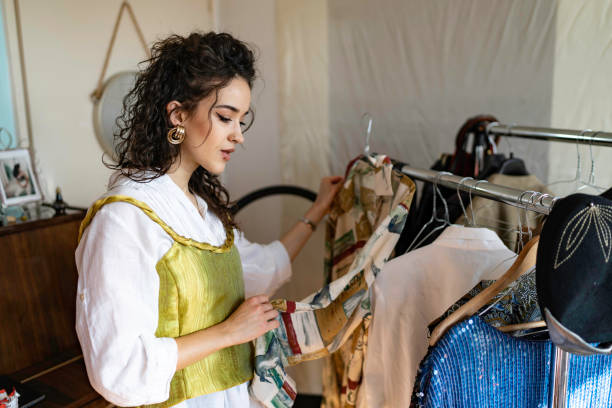
The IRL swap party is experiencing a renaissance that feels deeply aligned with the Brooklyn/Boho heart of the lifestyle. Think about it: you know that friend who always shows up in a corset top that you have never seen before, or the girl at the coffee shop whose vintage denim vest has a back patch that tells a story you want to borrow? The IRL swap cuts through the noise of fast fashion by creating a low-stakes, high-reward social experience. You bring your gently worn treasures—that Reformation dress you wore once to a wedding, the Zara blazer that is just a little too structured for your current soft-girl energy—and you trade them like baseball cards. But it is deeper than that. There is a sacred exchange happening. You are literally wearing someone else’s past, and that act carries a kind of intimacy that retail therapy can never replicate. The lore behind a swapped piece is half its value. You are not just getting a new top; you are inheriting a vibe. The IRL swap also solves the biggest problem with fast fashion: the fear of commitment. If you trade a piece and later realize it is not your frequency, you can bring it back to the next swap and let it flow to someone else. No buyer’s remorse, no return shipping label, no carbon guilt. Just a continuous cycle of wardrobe evolution, like a shared closet that the whole community has keys to.
On the flip side, the digital swap sphere is where the algorithm meets the aesthetic. Apps and platforms have evolved beyond the clunky forums of the early 2010s. Now, you can digitally list your items, browse curated closets of users whose taste you trust, and coordinate a swap that feels almost as personal as handing a dress over in person. The beauty of a digital swap is the sheer scale of curation. You are not limited to the fashion tastes of your five besties. You can connect with a girl in Austin who has the perfect boho fringe bag you have been manifesting, and she wants your barely-worn platform sneakers that are collecting dust in your hallway. It removes the awkward haggling of selling—nobody feels cheap when it is a straight trade. You are both walking away with something that sparks joy, and the only currency exchanged is trust and a shipping label. The digital format also caters to the “balling-on-a-budget” mentality perfectly. You are not spending cash, so your bank account stays safe. You are spending what you already have: clothes you no longer serve you. That is the kind of circular economy that feels less like a sacrifice and more like a secret handshake.
Some people still have the ick about wearing another person’s clothes. They worry about stains, smells, or the metaphysical residue of a stranger’s energy. But in 2026, that mindset is as outdated as low-rise skinny jeans. The swap culture—both IRL and digital—has normalized the idea that washing and rewearing is not just sanitary, it is a sustainable act of rebellion against a system that wants you to buy new every season. And there is a particular thrill in the hunt. When you swap, you are not just a passive consumer. You are an active participant in a micro-economy of taste. You have to negotiate, communicate, and sometimes curate a mood board to convince someone your off-white blazer is worth their vintage band tee. That effort makes the final acquisition feel earned. It is the opposite of the instant gratification Amazon Prime drip. It is slower, more intentional, and deeply satisfying.
For the upscale yet budget-conscious baddie, swapping is the logical endpoint of a smarter fashion philosophy. You do not need to own ten dresses for ten different occasions. You need access. Whether you are meeting a girl at a Brooklyn coffee shop to hand over a bag of clothes, or you are digital-vibing with a stranger in a Facebook group dedicated to boho minimalists, you are participating in the ultimate recycling program. One person’s “I wore this once, the vibe is off” becomes your “this is my entire personality now.“ It is a beautiful, chaotic, deeply economical system that rewards the resourceful. And honestly? It feels way better than paying full price for something that will end up in the donation pile in six months. The swap is not just a transaction. It is a conversation. It is saying, “I see your style, and I trust you with mine.“ In a world of fast, disposable everything, that kind of trust is the real luxury.
Articles